
Medical Dermatology
Psoriasis care that considers the whole person.
Psoriasis is a condition of the immune system that shows up on the skin. Modern treatment can control it well, and good care also looks at joints, heart and metabolic health.
Overview
Understanding psoriasis
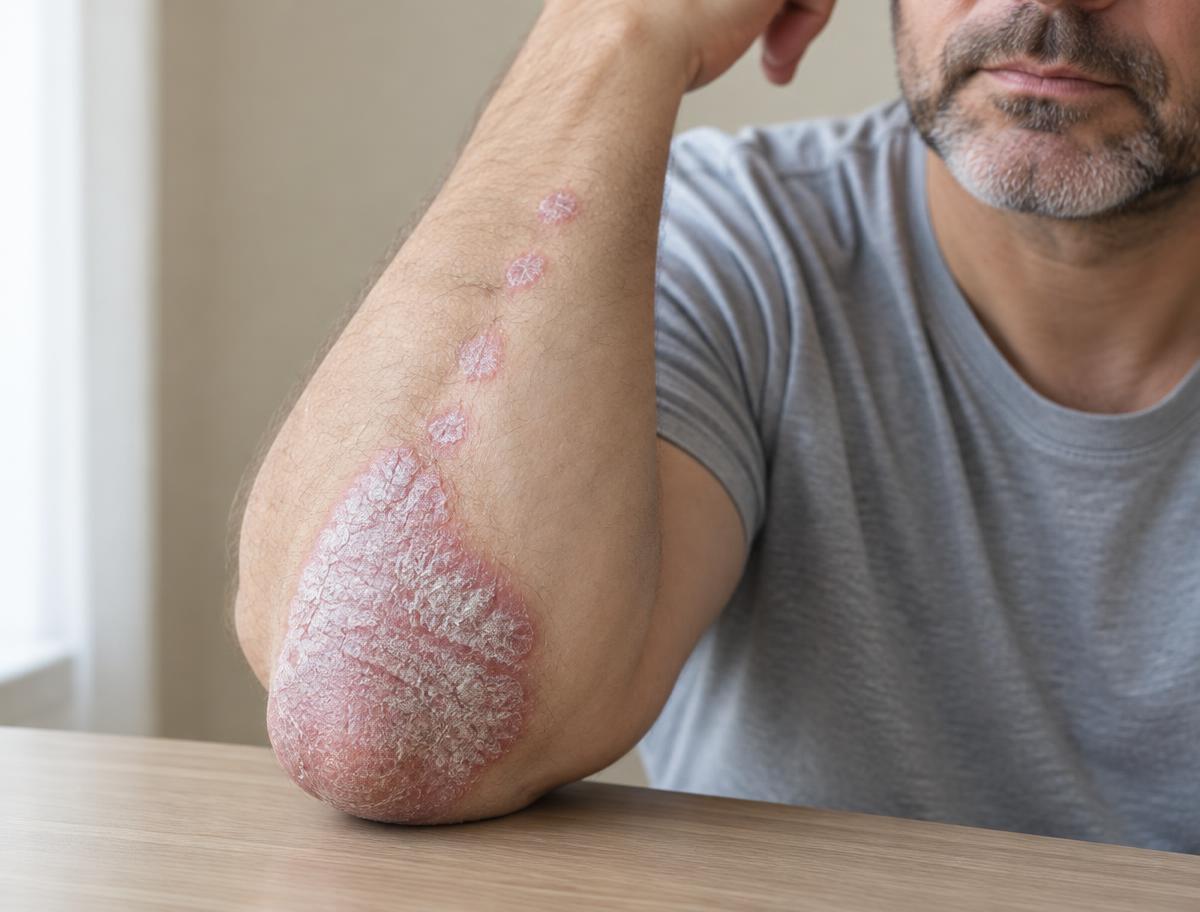
Psoriasis causes skin cells to turn over too quickly, producing thick, well-defined plaques with silvery scale. It commonly affects the scalp, elbows, knees, lower back, nails and body folds, and it can range from a few small patches to widespread involvement.
It is an immune-mediated condition, not an infection, and it is not contagious. Flares can follow stress, infection, skin injury, certain medications or cold dry weather.
Up to a third of people with psoriasis develop psoriatic arthritis, and psoriasis is associated with cardiovascular and metabolic disease. Dr. Gaul's Internal Medicine training is particularly useful here: joint symptoms and overall health are part of the conversation, not an afterthought.
Signs
What you might notice
- Thick, raised plaques with silvery-white scale
- Scaling in the scalp that extends past the hairline
- Nail pitting, ridging, thickening or separation from the nail bed
- Cracking or bleeding over joints and knuckles
- Itching, burning or soreness in affected skin
- Stiff, swollen or painful joints, particularly in the morning
Care
How we treat it
Topical therapy. Steroids, vitamin D analogues, topical retinoids, tar and newer non-steroidal topicals, with scalp-specific formulations for hair-bearing skin.
Light-based therapy. Phototherapy approaches for appropriate patients, including guidance on safe, controlled exposure rather than tanning.
Systemic and biologic therapy. Oral systemic medication and biologic therapy for moderate to severe disease or psoriatic arthritis, with laboratory monitoring and help with insurance authorization.
Whole-health measures. Attention to weight, smoking, alcohol, sleep and cardiovascular risk, which genuinely influence psoriasis severity.
Evaluation
How it’s diagnosed
Psoriasis is usually diagnosed by examination of the skin, scalp and nails, together with your history and family history. A skin biopsy is occasionally used when the presentation is atypical or overlaps with eczema or a fungal infection.
Dr. Gaul also screens for joint involvement and reviews cardiovascular and metabolic risk factors, and coordinates with your primary care physician or a rheumatologist when that is the right step.
This page is general education and is not medical advice, diagnosis or treatment, and it does not create a physician–patient relationship. Individual circumstances differ; please discuss your own skin with a qualified clinician. If you are having a medical emergency, call 911.
Questions
Frequently asked
No. Psoriasis cannot be spread by contact. It is an immune-mediated condition.
Not necessarily. Many patients do well with topical or light-based treatment. Biologics are considered when disease is moderate to severe, when joints are involved, or when other treatment has not worked.
Some systemic treatments address both skin and joint disease, which is one reason joint symptoms should be mentioned at your visit even if they seem unrelated.

Let’s take care of your skin.
Whether something has changed, something has been bothering you for years, or you simply want expert guidance on keeping your skin healthy, we’re here to help.